
PhD, HKUST · Expected Graduation: June 2027 · Focus: Frontier Agent Evaluation
I study how to evaluate frontier AI agents reliably as tasks, memory, and interaction horizons scale. Currently at Tencent Hunyuan researching agent harness and evaluation infrastructure. Previously at ByteDance building daemonized long-running agent systems.
Education
Hong Kong University of Science and Technology (2023 Fall – )
Doctor of Philosophy (PhD) in Electronic and Computer Engineering
Supervisor: Prof. Wei Zhang (HKUST) · Long-term collaborator: Prof. Bing Luo (DKU)
The Chinese University of Hong Kong, Shenzhen (2019 — 2023)
Bachelor of Engineering in Electrical and Computer Engineering, Computer Engineering Stream
Experience
Tencent | Senior Researcher (Hunyuan LLM Team, Qingyun Internship Program)
May 2026 – Present
- Research on agent4research harness — scalable evaluation and execution infrastructure for LLM-driven research agents.
- Research on harness eval — rigorous evaluation methodologies and benchmarks for long-horizon agent capabilities.
- Research on RSI (recursive self-improvement) evaluation — systematic evaluation framework for self-improving LLM research agents.
ByteDance | Intern (Agent Long-Horizon Self-Iterative Algorithm Systems)
Jan. 2026 – May 2026
- Led end-to-end implementation of a long-running agent and self-iterative algorithm project.
- Designed Daemon + Rubric + Harness architecture for daemonized scheduling, rubric-driven evaluation/iteration, and harness-based orchestration.
- Enabled Auto / Interactive / Human-Interrupt modes for autonomous execution and manual takeover.
- Built robust state management with stage transitions, failure recovery, and human handoff.
Research Focus
Frontier Agent Evaluation Long-Horizon Agents Benchmark Validity Agentic RL
My research focuses on frontier agent evaluation: measuring what long-running agents can actually do, where they fail, and whether benchmark scores reflect the intended capabilities.
- Process and long-horizon evaluation — measure evidence gathering, recovery, calibration, and memory reliability as agents interact over time (SeekBench; scale-conditioned memory evaluation).
- Benchmark validity and research-agent evaluation — audit reward-hacking exposures and build rigorous evaluation harnesses for autonomous research agents (HackDetect; Tencent Hunyuan).
- Agent algorithms and systems — study stable multi-turn RL and execution infrastructure that support sustained agent behavior (FoldAct; ByteDance).
Representative Research
SeekBench: Benchmarking Epistemic Competence in LLM Search Agents
ICLR 2026 First Author Benchmark & Evaluation
- Developed a standardized benchmark evaluating LLM search agents beyond end-task accuracy — measuring how agents search, not just whether they succeed.
- Introduced trajectory-level metrics: Groundedness, Recovery, and Calibration.
- GitHub · arXiv
HackDetect: Protocol Validity and Reward-Hacking Audit for Agent Benchmarks
arXiv 2026 First Author Benchmark Audit
- Formulated protocol validity for agent benchmarks and developed a post-hoc audit framework to identify reward-hacking exposures.
- Audited 2,385 traces across 15 agent benchmarks; found evidence of exposures in 67% of Frontier Science and 66.7% of AutoLab traces.
- Measured score inflation of 0.45–1.00 across paired comparisons, showing benchmark reports must provide evidence that scores reflect intended capabilities.
- arXiv
When Stored Evidence Stops Being Usable: Scale-Conditioned Evaluation of Agent Memory
NeurIPS 2026 ED Track Co-first Author Evaluation Protocol
- Presented a scale-conditioned evaluation protocol for agent memory under evidence-preserving growth: task evidence fixed, irrelevant sessions added.
- Reported four trajectory-level diagnostics: budget-compliant reliability, tail memory-call burden, failure-regime decomposition, and usable-scale boundary.
- Showed that reliability loss is not a single phenomenon — similar drops can hide entirely different failure regimes across memory interfaces.
- arXiv
FoldAct: Efficient and Stable Context Folding for Long-Horizon Search Agents
arXiv 2025 First Author Algorithm
- Proposed a context-folding algorithm for long-horizon LLM agents under multi-turn RL.
- Achieved up to 5.19× training speedup while maintaining strong long-horizon decision quality.
- GitHub
MorphAgent: Self-Evolving Multi-Agent Collaboration Platform
ICML-MAS 2025 Co-first Author Multi-Agent System
- Designed a decentralized collaboration framework where LLM agents dynamically evolve roles without predefined structures.
- Demonstrated improved task performance, transferability, and robustness across reasoning and coding benchmarks.
Beyond Right to be Forgotten: Managing Heterogeneity Side Effects Through Strategic Incentives
ACM MobiHoc 2025 First Author Federated Learning
- Studied heterogeneity side effects in federated unlearning under non-IID data.
- Developed a Stackelberg-game-based incentive mechanism to retain crucial clients and improve stability.
Publications
2026
- Shao, J., Lin, Y., Lohani, M. P., Miao, Y., and Luo, B., "Do LLM Agents Know How to Ground, Recover, and Assess? A Benchmark for Epistemic Competence in Information-Seeking Agents", ICLR 2026. 🎉 [arXiv] [Code]
- Shao, J., "HackDetect: Protocol Validity and Reward-Hacking Audit for Agent Benchmarks", arXiv e-prints, arXiv:2607.22368, 2026. [arXiv]
- Shao, J., Lu, Y., Zhang, Y., and Luo, B., "When Stored Evidence Stops Being Usable: Scale-Conditioned Evaluation of Agent Memory", NeurIPS 2026, Evaluations & Datasets Track. 🎉 (*Equal contribution with Y. Lu) [arXiv]
2025
- Shao, J., Lin, T., Zhang, X., Yang, Q., and Luo, B., "Beyond Right to be Forgotten: Managing Heterogeneity Side Effects Through Strategic Incentives", ACM MobiHoc 2025. 🎉
- Lu, S.*, Shao, J.*, Luo, B., and Lin, T., "MorphAgent: Empowering Agents Through Self-Evolving Profiles and Decentralized Collaboration", ICML-MAS 2025. (*Equal contribution)
- Shao, J., Yuan, T., Lin, T., and Luo, B., "Cognitive Insights and Stable Coalition Matching for Fostering Multi-Agent Cooperation", arXiv e-prints, arXiv:2405.18044.
- Fan, T., Gu, H., Cao, X., Chan, C. S., Chen, Q., Chen, Y., Feng, Y., Gu, Y., Geng, J., Luo, B., Liu, S., Ong, W. K., Ren, C., Shao, J., Sun, C., Tang, X., Tae, H. X., Tong, Y., Wei, S., Wu, F., Xi, W., Xu, M., Yang, H., Yang, X., Yan, J., Yu, H., Yu, H., Zhang, T., Zhang, Y., Zhang, X., Zheng, Z., Fan, L., and Yang, Q., "Ten Challenging Problems in Federated Foundation Models", IEEE TKDE, 2025.
2024
- He, S., Tang, B., Zhang, B., Shao, J., Ouyang, X., Nugraha, D. N., and Luo, B., "FedKit: Enabling Cross-Platform Federated Learning for Android and iOS", IEEE INFOCOM WKSHPS, 2024.
- Geng, J., Tang, B., Zhang, B., Shao, J., and Luo, B., "FedCampus: A Real-world Privacy-preserving Mobile Application for Smart Campus via Federated Learning & Analytics", ACM MobiHoc (Demo), 2024.
2023
- Shao, J., Han, S., He, C., and Luo, B., "Privacy-Preserving Federated Heavy Hitter Analytics for Non-IID Data", FL-ICML Workshop, 2023.
Projects
MASArena: Benchmarking Framework for Multi-Agent Systems
Open Source System
- Led design and implementation of a modular benchmarking framework for single- and multi-agent systems, co-developed by DKU-Edge Intelligence Lab and Westlake University LINs-Lab.
- Architected plug-and-play modules, built-in benchmarks, visual debugging, and seamless agent/tool/dataset integration.
- GitHub →
FedKit: Cross-Platform Federated Learning for Mobile
Mobile Federated Learning
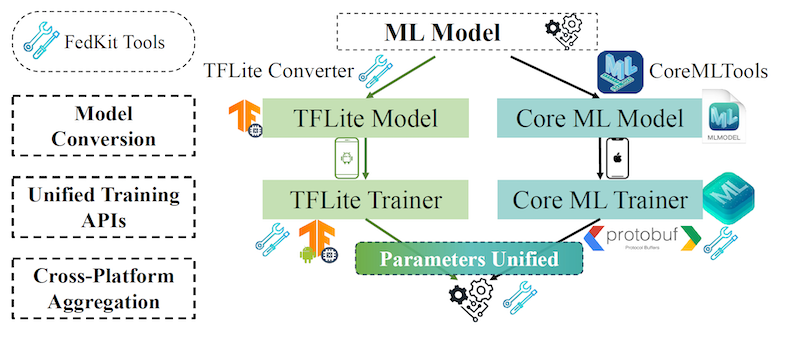
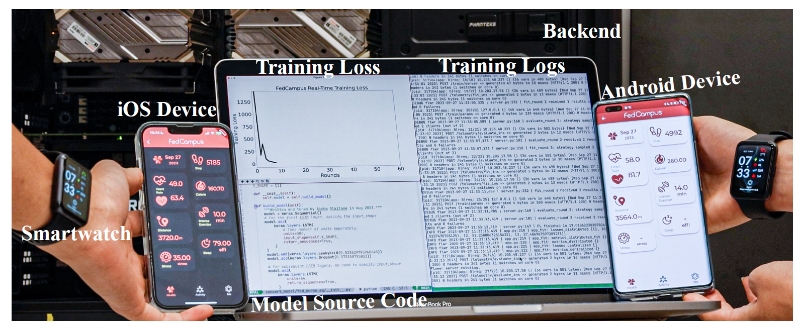
- Pipelined cross-platform FL for Android and iOS with model conversion, hardware-accelerated training, and cross-platform aggregation.
- Accepted at IEEE INFOCOM 2024 Demo 🎉.
 |
 |
|---|---|
| FedKit Pipeline Overview | FedKit Simulation |
FedCampus: Privacy-Preserving Smart Campus Platform
Mobile App Differential Privacy
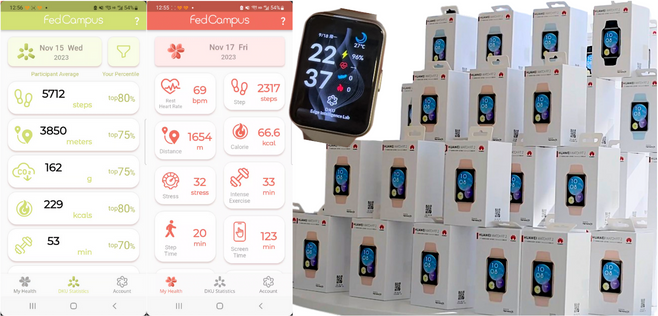
- Privacy-preserving smart campus application on Android and iOS, implementing Federated Learning and Differential Privacy.
- 100+ customized smart watches deployed at DKU.
- Video →
 |
|---|
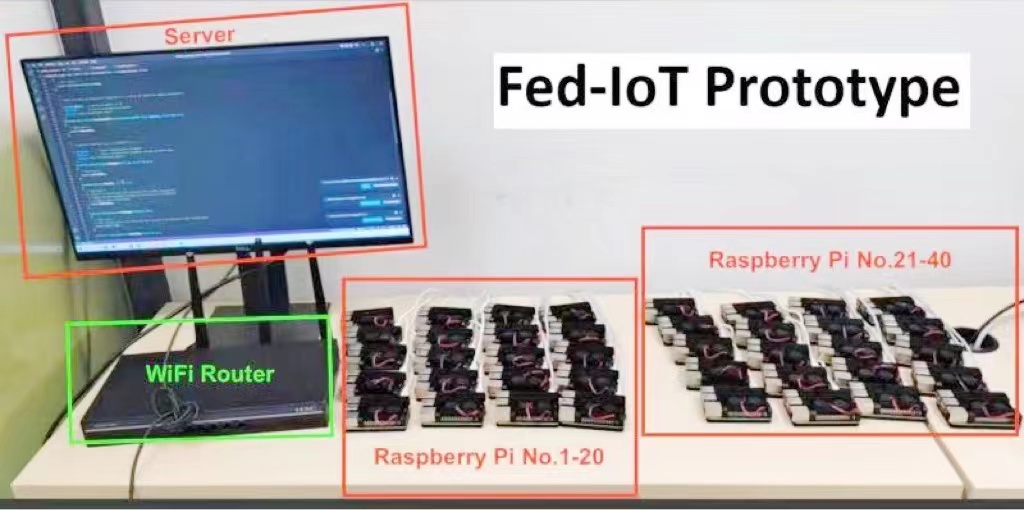
Edge-based Cross-device Federated Learning Prototypes
IoT Edge Computing
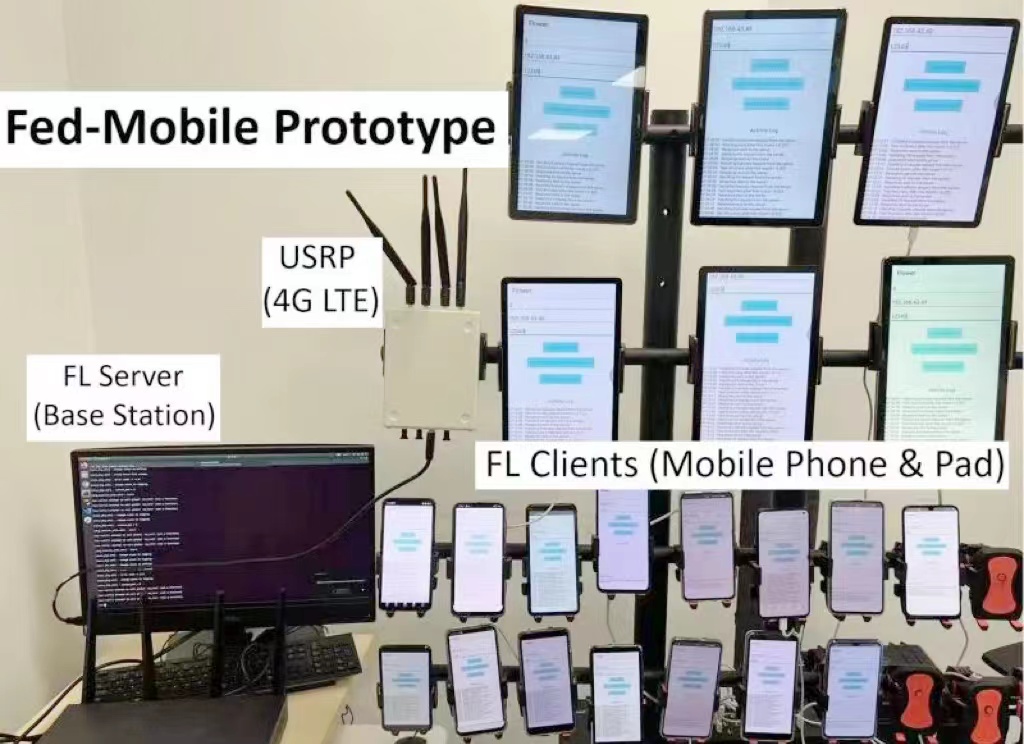
- Prototype supporting Mobile and IoT devices over WiFi and USRP-based 4G/5G wireless networks.
Talks & Invited Seminars
- Vibe Coding Seminar, Duke Kunshan University (DKU), April 2025
Teaching Assistant
- ELEC3120: Computer Communication Networks (HKUST, Spring 2024)
- ELEC3300: Introduction to Embedded Systems (HKUST, Fall 2024)
- ECE 586K: Vector Space Methods with Applications (DKU, Spring 2025)
- ECE 590K: Advanced Topics in Electrical and Computer Engineering (DKU)
Patents
- B. Luo, J. Shao, “Method and Apparatus for Online Parameter Selection in Minimizing the Total Cost of Federated Learning”, CN202310485067.8, Apr. 2023
- B. Luo, J. Shao, “Method and Apparatus for Online Client Sampling in Minimizing the Training Time of Federated Learning”, CN202310484383.3, Apr. 2023
- B. Luo, J. Shao, J. Huang, “Method and Apparatus for Frequent Items Mining Using Federated Analytics”, CN202310365167.7, Mar. 2023
- B. Luo, J. Shao, J. Huang, “Method and Apparatus for Frequent Data Mining Based on Hierarchical Federated Analytics”, CN202310330791.3, Mar. 2023